In den letzten 20 Jahren hat die Luftfahrtindustrie massive Fortschritte in der Flugzeugkonstruktion und den Betriebsverfahren erlebt.
Die folgende Karte zeigt, wie sich unsere Lärmschutzzonen (55 dB Lden) seit dem Jahr 2012 verändert haben.

In den letzten 20 Jahren hat die Luftfahrtindustrie massive Fortschritte in der Flugzeugkonstruktion und den Betriebsverfahren erlebt.
Die folgende Karte zeigt, wie sich unsere Lärmschutzzonen (55 dB Lden) seit dem Jahr 2012 verändert haben.

Die folgende Karte zeigt die im Jahr 2022 vom Bundesministerium für Klimaschutz, Umwelt, Energie, Mobilität, Innovation und Technologie veröffentlichten Lärmzonen für den Flughafen Salzburg.
Alle Informationen dazu finden Sie hier.

At Gatwick, we have a dedicated team called the Airspace Office whose focus is to continually monitor aircraft operations to ensure compliance with the noise abatement requirements applicable to the airport. The team also oversees the implementation of the airport’s Noise Action plan and undertakes proactive engagement with airlines to drive continuous improvement.
You can read the action plan here and we’ve identified some of our key programs for arriving aircraft below:
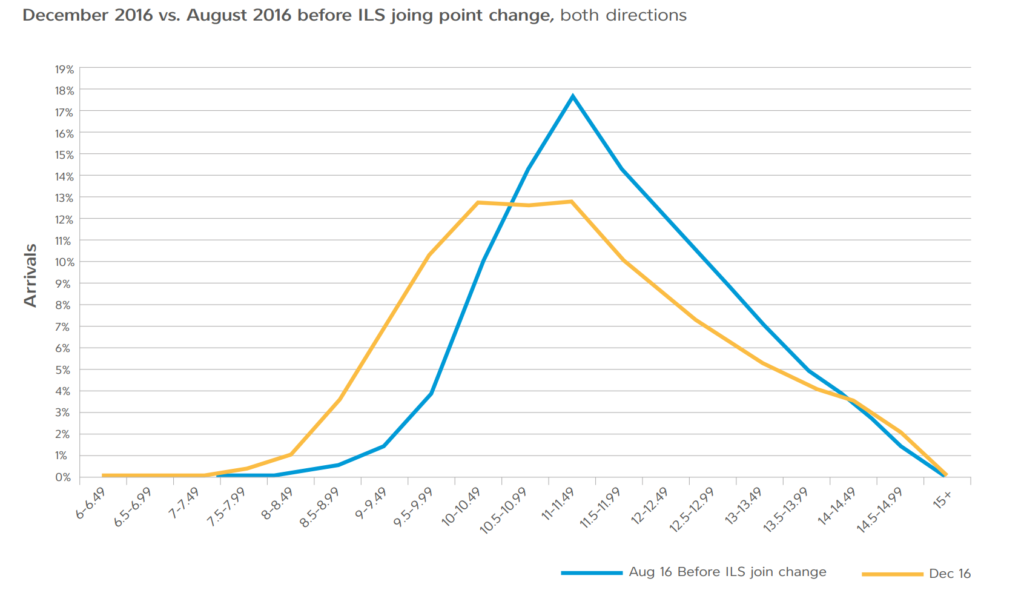
A key recommendation of the Independent Arrivals Review was to make a change to how aircraft arrive at the airport. With the change seeking to increase the spread of arriving aircraft to reduce the peak impact in heavily overflown areas.
The change was implemented as part of a trial in August 2016 to test the procedure and determine if it would meet the overall aim. And, in late 2017 the Noise Management Board voted to adopt the procedure permanently as it had delivered the expected results.
It is worth nothing that the analysis considered long-term trends and day-to-day traffic levels can vary, this is especially true in the busy summer months.
In 2018 the Noise Management Board agreed to investigate additional options to continue to improve the management of arriving aircraft. Their findings likely to be taken-up within the larger re-design of the UK’s airspace, within the UK Government’s Future Airspace Strategy – Southern Implementation (FASI-South).
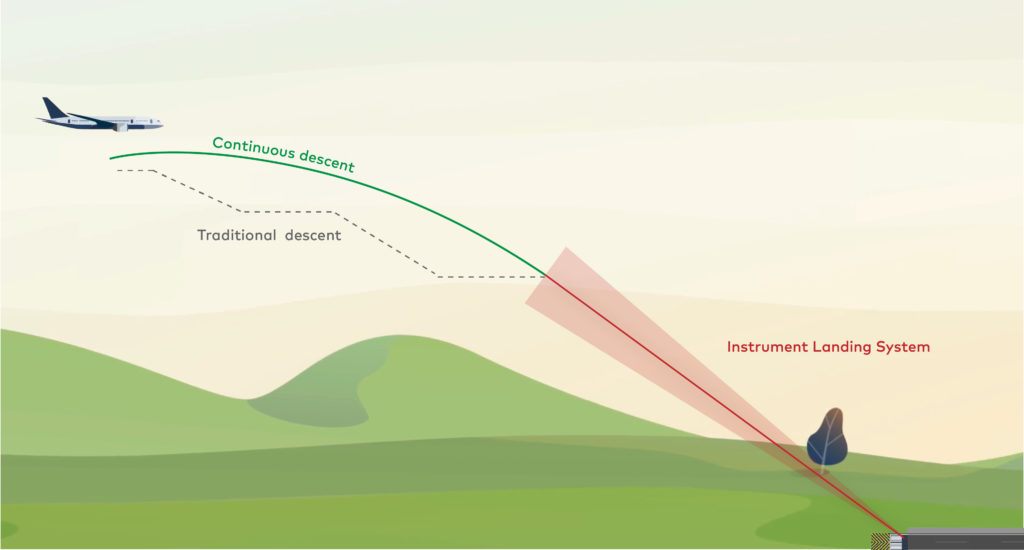
Gatwick Airport requests pilots perform a Continuous Descent Approach (CDA) which seeks to minimise the use of the throttles on approach with the pilots working closely with Air Traffic Control (ATC) to ensure the aircraft can perform a steady glide down to landing. This not only reduces the need for engine power, but it also keeps the aircraft much higher, as shown in the diagram.
In addition to maintaining a CDA, Gatwick Airport also requests pilots utilise low power, low drag procedures (LPLD).
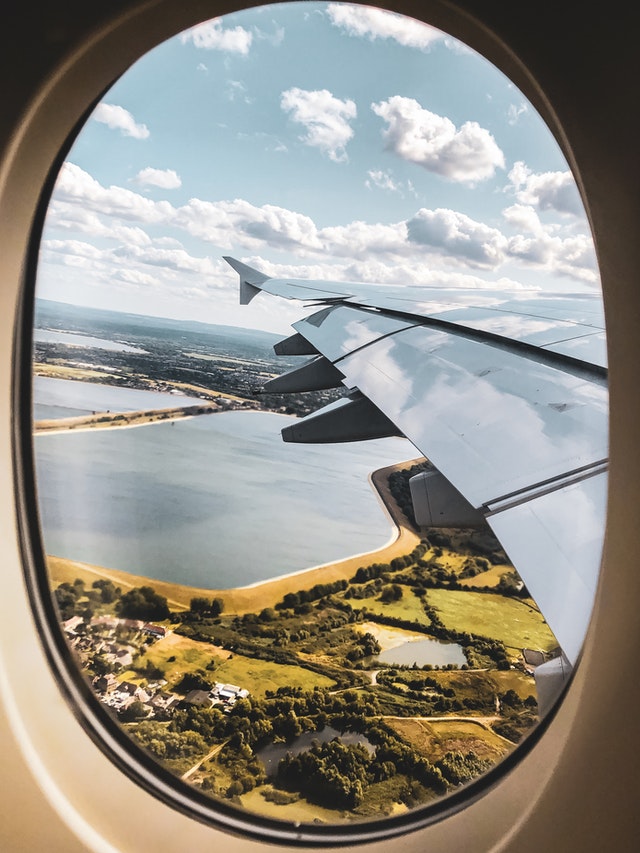
These procedures seek to delay the extension of flaps and slats until a late stage of the approach. Flaps and Slats are additional surfaces on the wing that can be extended prior to landing to provide additional lift to allow a safe landing, but they can also generate additional noise which can be heard on the ground, you can see a picture of the flaps extended on the wing opposite.
Gatwick Airport is also exploring with its airlines opportunities to also delay the extension of the aircraft’s landing gear until it is on the final approach.
More than half of the flights at Gatwick are conducted by the Airbus A320 series of aircraft. This family of airliners have a design characteristic which can cause increased airframe noise in the aircraft’s approach phase of flight. Airbus has developed a Fuel Over Pressure Protector (FOPP) modification to eliminate these effects.
The modification enables a significant reduction in the high-pitched whine compared with unmodified aircraft, and this is having a real impact in reducing noise disturbance. And as a result, the modification of these airliners, using the Airbus designed kit, was identified as a priority by Gatwick Airport.
Gatwick’s objective is that all A320 series aircraft using Gatwick are fitted with the Airbus noise reduction kit and inline with that objective Gatwick announced that with effect from 1st January 2018, higher noise charges will apply to any A320 family aircraft that does not have the FOPP modification. The charge has been set at a level which will provide a strong financial incentive to each airline to ensure that their aircraft fleet operating out of Gatwick has the FOPP modification.
Several home-based airlines have confirmed that they are accelerating their modification programmes as a result of this new charging structure.
To date, over 300 aircraft have been modified, delivering a large noise reduction not only to those who live around Gatwick Airport, but to all of those located across Europe where all of these A320 family aircraft operate.

Gatwick Airport’s Noise Insulation Scheme applies to eligible homes across Surrey, Sussex and Kent who can apply for up to £3,000 plus VAT towards double glazing for their windows and doors as well as loft insulation. This allowance is based upon an industry price agreed by Gatwick Airport meaning that you can often get more than you expect.
Following a period of consultation, Gatwick Airport extended the scheme to benefit a further 985 homes and ensured the boundary includes entire roads and villages as shown in the image below.
The airport has previously written to those who are eligible with more details of the scheme and how to apply, but we have included some of the common questions that we are asked below:
To help reduce the impact of airport noise on households most affected by aircraft noise from Gatwick Airport as the number of passengers grows to 46 million per year (from just over 34 million passengers a year in 2012/13.
We propose that for those residents who fall within the scheme boundary any window or exterior door will qualify. In addition, acoustic loft insulation is also available.
Interior doors and windows are not included in the scheme, along with conservatories as these are not classed as living space. Secondary-glazing of doors is not generally seen as effective in reducing noise and so will not be offered. All rooms that serve a commercial purpose in a building are not eligible under this scheme. This includes offices, retail outlets and workshops.
You can have a mixture and you may decide to have high-specification, replacement double-glazed windows fitted in rooms where they require a high-level of noise insulation, and standard, replacement double-glazed windows or secondary glazing in other rooms. In addition, the scheme also offers ventilation, secondary glazing and loft insulation, in cases where the initial survey identifies these as viable options.


The area to the north west of Gatwick Airport is home to a specialist training area for Police, First Responders and Airport Security Staff from across the country. It ensures that those who work to protect the travelling public are training to the highest possible standards and ensure that those high standards are maintained at all times.
Courses are typically run on a quarterly basis and due to the nature of the training, loud bangs may be heard in nearby areas. These loud bangs are a critical part of the training and whilst it is not possible to remove them entirely, Gatwick Airport and Security Training Teams take all practical measures to ensure that disturbance to the local community is kept to a minimum.
We also publish the dates that we expect these training courses to take place on this website, however due to the Covid-19 Pandemic all future courses have currently been suspended.
Route 4 is a departure route for aircraft taking off from Gatwick toward the west. Soon after take-off aircraft wrap 180 degrees round to the right and heads east, flying close to areas of South Holmwood, Leigh, Redhill and Reigate.
An airspace change was initiated in 2012 and had sought to upgrade the navigational technology to the latest satellite-based technology had just been completed. However, a community group – Plane Justice sought a judicial review that challenged the CAA’s Post Implementation Review decision to ratify that revised Route 4 departure route. And following ‘detailed and lengthy investigations’ the CAA asked the court to quash their previous decision.
The reason the CAA felt it could not allow their Post Implementation Review decision to stand was that during the process of responding to litigation the CAA discovered that the historical changes to the conventional route were not for entirely the reasons originally identified. Because this information was not previously available to either the CAA or Gatwick, the CAA considered that that the airport could not have conducted a proper consultation in 2016 and therefore it could not allow its decision to stand.

The Route 4 Standard Instrument Departures remain in place but have a temporary status as was the case prior to the CAA’s decision in April 2017. Aircraft departing Gatwick and flying along Route 4 will continue to use these routes.
Gatwick initiated a new full Airspace Change Proposal (ACP) for Route 4 in December 2018. We expect to be able complete the CAA airspace change process and implement new Route 4 RNAV Standard Instrument Departures in the first half of 2021. Full details of all our airspace change can be found on the CAA’s airspace change portal; just enter ‘Gatwick’ into the search function.
We expect that the CAA will in due course draw to a close the 2012 airspace change on Route 4 and we are waiting for a CAA decision on this matter.